

Chandratal Lake Camping: What It Is Really Like to Sleep at the Moon Lake

Updated: Jul 24

We had just finished the Batal stretch on one of our Spiti trips when the group finally reached Chandratal for our first Chandratal lake camping night.
Everyone was tired. Dusty. Running on whatever was left after three days of mountain roads. The walk in from the parking point is about two kilometres and by the end of it the energy was purely functional, just enough to get there.
The first ten minutes were predictable. Photos, reels, drone footage, everyone trying to get their shot with the lake before the light changed. Normal group behaviour.
Then we asked everyone to walk slowly towards the water and just stand there for a bit.
There was one guy in the group who had been the loudest presence the entire trip. Constant jokes, music playing from his phone in the tempo, full energy from Day 1. The kind of person whose silence you would notice.
He reached the lake, looked at it, and sat down.
No phone. No talking. No calling anyone over. Just sitting.
Within fifteen minutes, without anyone suggesting it, the whole group had scattered quietly around the lake. Nobody talking. Nobody photographing. Just people and water and silence at 4,300 metres.
On the walk back to camp he said one thing.
"I didn't expect this place to shut me up."
That is what Chandratal does. Not dramatically. Not loudly. It just slows people down without them realising it is happening.
What Chandratal Actually Is
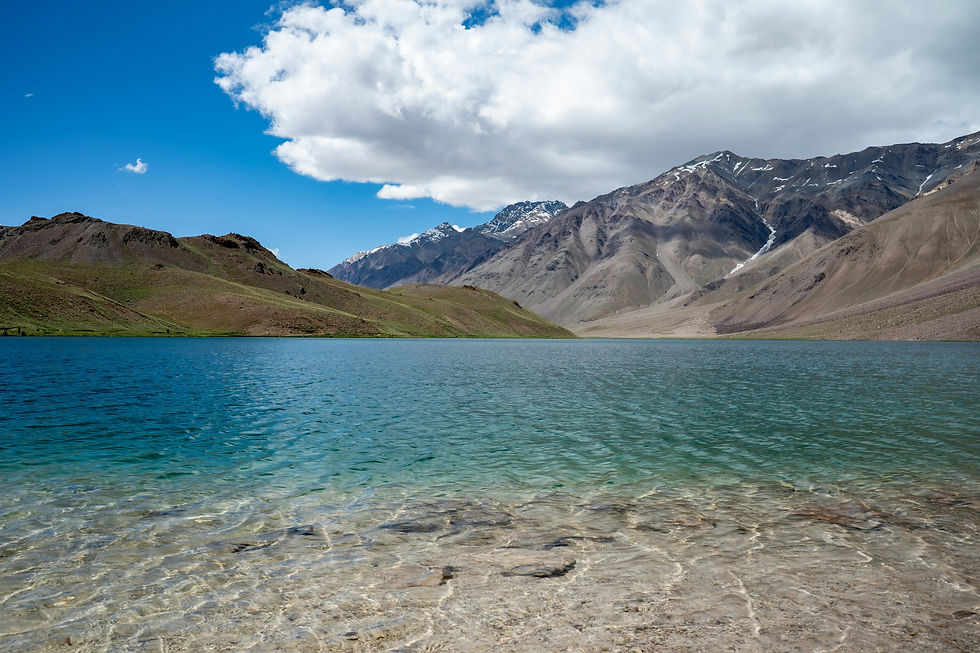
Chandratal, which translates to Moon Lake, sits at 4,300 metres in the high grasslands above the Spiti Valley. The lake is crescent-shaped, which is where the name comes from, and covers roughly 2.5 square kilometres at an altitude where the air is thin enough that walking faster than a stroll is a deliberate choice.
The water changes colour through the day. Steel blue at sunrise, turquoise by mid-morning, occasionally emerald when the cloud cover creates the right light conditions. At night, with no artificial light within hours in any direction, the Milky Way reflects off its surface.
Camping here is not comfortable. The temperatures drop below freezing even in July. The facilities at the campsites are basic. There is no network, no electricity from the grid, no way to order anything or reach anyone outside of the valley.
That combination of extreme discomfort and extreme beauty is exactly why people leave changed.
The Folklore of Chandratal Lake

The locals who have lived around this valley for generations do not treat Chandratal as a tourist destination. They treat it as a sacred site, and the stories that have been passed down reflect that.
The Mahabharata Connection
The most widely told legend about Chandratal connects it to the Pandavas. According to local belief, Yudhishthira, the eldest of the five brothers, was taken from this very lake to heaven by Lord Indra's chariot at the end of the Mahabharata age. The lake is considered a threshold, a point where the mortal world and something beyond it briefly touch.
Whether you hold that belief or not, standing at the edge of Chandratal at dusk and watching the light go off the water, you understand why people across centuries located something sacred here.
The Shepherd Who Never Came Back
There is a quieter story told by older locals about a shepherd who grazed his flock in the grasslands near the lake every summer. One season, he did not return. His sheep walked back to the village alone and were found waiting outside the gate in the morning.
No body was ever found. The lake gave nothing back.
Locals believe his spirit still moves around the lake, protective rather than threatening, a guardian presence that explains why the place feels inhabited even when there is nobody else around.
The Buddhist and Hindu Overlap
Chandratal is revered across both traditions. Buddhist prayer flags are tied near the approaches to the lake. Hindu pilgrims come for the Mahabharata connection. The overlap is not unusual in the Himalayan valley culture where the two traditions have existed alongside each other for centuries, but Chandratal is one of the places where that coexistence feels particularly natural, as if the lake itself belongs to both.
Why Chandratal Lake Camping Feels Magical

Let us be direct about this because most guides are not.
The cold is serious. Even in peak summer, July and August, temperatures at Chandratal drop well below freezing at night. The altitude amplifies the cold in ways that city-dwellers do not fully account for. People who pack for a Himalayan summer and assume the camping will be manageable with a light sleeping bag are the ones who spend the night miserable rather than looking at stars.
The campsites are not at the lake. Camping directly beside Chandratal is prohibited for ecological reasons. The regulated campsites are approximately 2 to 3 km from the lake. You walk in from the camp, spend time at the lake, and walk back. This is the right way to do it. The ban exists because unrestricted camping was damaging the ecosystem around the lake and the regulation has made a visible difference to the condition of the shoreline.
There is no network. Zero. Download offline maps and save anything you need before you lose signal at Batal. Read our Spiti Valley packing list for the full connectivity and Jio SIM guidance before this leg.
The facilities are basic. Dry-pit or shared bio-toilets. Dal rice, Maggi, eggs at the camp kitchen. A power bank because there is no reliable electricity. These are not complaints, they are facts worth knowing before you arrive expecting something different.
The Batal stretch is rough. The road from Batal to the Chandratal camping area is one of the most corrugated sections on the entire Spiti circuit. Depending on the season and recent rainfall, it can involve river crossings. This is not a road you drive at night or rush through.
The altitude hits differently at night. You may feel fine during the day at the lake. At night, lying down at 4,300 metres, some people notice headaches, shallow breathing, or disrupted sleep. This is normal mild altitude adjustment. If symptoms worsen rather than stabilise, it is a signal to descend. Read our Spiti acclimatisation guide before this part of the trip.
Why the Night at Chandratal Is Worth All of It

None of the discomfort is what people remember.
The lake reflects the stars as if the sky has folded into the earth. The Milky Way, which is theoretical in most cities and real but distant in most mountain destinations, is right there at Chandratal. Overhead. Dense and immediate in a way that makes the distance feel personal rather than abstract.
At moonrise, the glow turns the mountains around the lake into soft silhouettes and the water becomes something that photographs try to capture and consistently fail to.
The morning is different again. The grasslands in the early light before anyone else is moving, the lake surface still, the cold making every breath visible, and the knowledge that you are somewhere very few people in the country have actually been. Not because it is inaccessible but because it requires enough commitment that most people do not make it.
What to Pack for Chandratal Camping

Beyond the standard Spiti packing list, these items are specific to the camping night.
Sleeping bag rated to minus 10 degrees minimum. The campsite rentals are often not warm enough. Bring your own if you have one, or confirm the rating of the rental before you commit to it.
Thermal base layers top and bottom for sleeping. The amount of cold that comes through a tent at 4,300 metres overnight is not something one fleece handles.
Headlamp with spare batteries. Night bathroom trips at a remote campsite without one are genuinely inconvenient.
Power bank fully charged. No electricity for recharging anything.
Extra water and snacks for the walk to and from the lake since the camp food timings do not always align with when you want to eat.
A garbage bag. Take everything you bring in back out. The fragility of the ecosystem around Chandratal is real and littering here does damage that takes years to undo.
Best Time for Chandratal Camping
The lake is accessible from mid-June, when Kunzum La clears of winter snow, to early October when the passes begin closing again. Check current road status before planning this leg since the opening date varies each year. Our Chandratal opening date post tracks the current season status.
July and August are the most popular months. The grasslands are green, the weather is relatively stable, and the camping operators are all running. River crossings on the Batal road are more active during these months due to snowmelt.
September is our preferred month for the Chandratal night. The crowds thin out, the sky is clearer, the cold is still manageable with proper gear, and the colours around the lake in the pre-autumn light are the best of the season.
Go with a trusted operator: Local expertise matters in extreme terrains.
Camping at Chandratal with Panny Fack India

Chandratal camping is the final night on our Spiti road trip before the descent to Manali. We set up at a regulated campsite, walk to the lake for the evening, and spend the night at altitude before the last day of the circuit.
It is the part of the trip most groups reference when they talk about it later. Not the passes or the monasteries or the drives, though all of those are extraordinary. The night at Chandratal is the one that stays.
Browse our Spiti Valley itinerary 9 days to see how the full circuit is structured around this stop, or see our Spiti Road Trip and Spiti Bike Trip for the full trip details.
Browse all our Road Trips or check our Weekend Trips if you are still deciding on a destination.
FAQs: Chandratal Camping
Can you camp right next to Chandratal Lake?
No. Camping directly beside the lake is prohibited under environmental regulations. All regulated campsites are 2 to 3 km from the lake. You walk in to visit the lake and return to camp for the night.
How cold does it get at Chandratal at night?
Temperatures can drop to minus 5 to minus 10 degrees at night even in July and August. A sleeping bag rated to at least minus 10 degrees is essential. Do not rely on campsite rental sleeping bags without confirming their rating.
Is Chandratal camping safe?
Yes, when done with a regulated campsite operator and proper preparation. The main risks are altitude sickness, cold exposure, and the rough road access. All three are manageable with the right preparation and a trip operator who has done this route before.
When does Chandratal open for camping?
Typically mid-June when Kunzum La clears. The exact date varies each year depending on winter snowfall. Check current road and lake status before finalising plans.
Is there network at Chandratal?
No. Download everything you need before Batal. There is no mobile signal at the lake or the campsites.
What is the road to Chandratal like?
The Batal to Chandratal stretch is one of the roughest sections on the Spiti circuit. Corrugated gravel road with possible river crossings depending on the season. Not suitable for standard cars. SUVs and tempo travellers manage it with an experienced driver.
How far is Chandratal from Kaza?
Approximately 115 km via Kunzum La. The drive takes 4 to 5 hours depending on road conditions and weather.
Panny Fack India takes groups to Chandratal as part of the Spiti circuit every season. The camping night at the lake is included on every departure. See the Spiti Road Trip or WhatsApp us with your dates.


Comments