

High Altitude Lakes in India: 5 You Need to See Before You Die


India has thousands of lakes. Most of them are perfectly fine.
The ones at altitude are different.
Above 4,000 metres, the air thins, the light changes, and water takes on colours that have no real equivalent at sea level. Blues that shift between turquoise and cobalt within the same hour depending on the cloud cover. Greens that appear briefly at dawn and then disappear. Silvers that emerge when the wind drops and the surface goes completely still.
These are not lakes you drive past. They are lakes you plan expeditions around, spend days reaching, and then stand beside in silence because no conversation feels equal to what you are looking at.
We visit most of the lakes on this list on our Spiti, Ladakh, and Zanskar road trips every season. This is our honest guide to the five high altitude lakes in India worth building a trip around, plus one that deserves its own mention at the end.
1. Chandratal Lake, Spiti Valley

Altitude: 4,300 metres
Best time to visit: June to September
How to reach: Via Manali or Spiti circuit, rough road from Batal
Chandratal, which translates to Moon Lake, sits in the high grasslands of Spiti at 4,300 metres and changes colour across the day in a way that makes people stop whatever they are doing and just watch.
At sunrise the water is steel blue. By mid-morning it shifts towards turquoise. By afternoon, depending on the cloud cover, it can look almost emerald. At night, with no artificial light within hours in any direction, the Milky Way reflects off its surface in a way that has made grown adults sit outside their tents at 2 AM in freezing temperatures simply because going inside feels like a waste.
The lake is crescent-shaped, which is where the moon reference comes from. The walk around the perimeter takes about an hour at altitude pace, which is slower than you think it will be. The silence is complete except for the wind.
We end our Spiti road trip with a night at Chandratal camp before the descent to Manali. For most groups it becomes the image they carry home when everything else from the trip starts to blur together. Read our Spiti Valley itinerary 9 days to see how we build the route around this stop.
Practical note: Chandratal opens in June once the Kunzum Pass road clears. The camping area has basic facilities. Carry cash, warm layers, and a good sleeping bag. The temperature drops below zero at night even in August.
2. Pangong Tso, Ladakh
Altitude: 4,350 metres
Best time to visit: May to October
How to reach: Via Leh, over Chang La pass at 5,360 metres
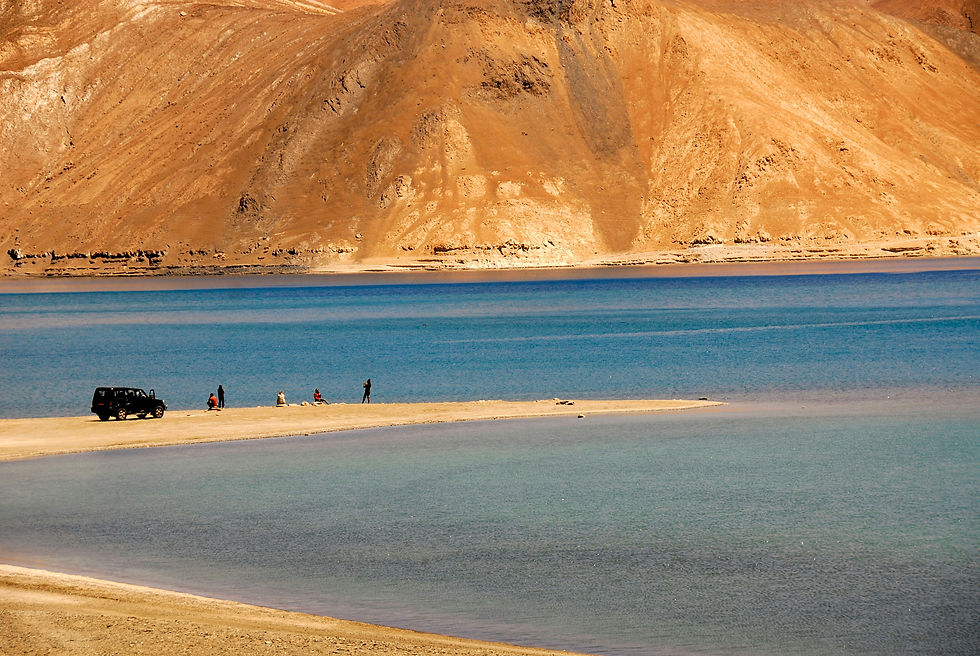
Pangong Tso stretches 130 km across the India-China border, with roughly a third of it in India. What the photograph does not tell you is that the colour changes every twenty minutes.
It is not one blue. It is a sequence of blues, shifting from pale grey in the early morning to intense cobalt by mid-morning to a deep, almost violet blue in the late afternoon light. The mountains on the far shore are bare and brown and the contrast between those two things, the stark rock and the impossibly coloured water, is what people are actually trying to photograph when they point their cameras here. Very few succeed. The experience does not compress.
The road over Chang La to reach Pangong is itself part of the journey. At 5,360 metres it is one of the highest motorable passes in the world and the descent to the lake on the other side is one of the great road trip moments in India, the moment the lake first appears in the valley below and the whole vehicle goes quiet.
Pangong is a planned stop on our Ladakh road trip. We camp on the lakeshore overnight, which is the only way to experience it properly since the day trippers from Leh are gone by evening and the lake becomes entirely your own.
Practical note: Inner Line Permit required for Indian nationals. Arrange in Leh before heading out. Foreigners require a Protected Area Permit.
3. Tso Moriri, Ladakh

Altitude: 4,522 metres
Best time to visit: June to September
How to reach: Via Leh and Chumathang, roughly 240 km from Leh
Tso Moriri is what Pangong would be if nobody had made a film there.
It is more remote, less visited, and sits at a slightly higher altitude in a valley that feels more enclosed and therefore more private. The Tsomoriri Wetland Conservation Reserve surrounds it, which means the wildlife here is genuinely present. Kiangs, the wild asses of the plateau, graze on the far shore. Migratory birds, including bar-headed geese that cross the Himalayas at altitude during migration, nest here. Marmots appear and disappear along the rocky margins.
The village of Korzok on the shore is one of the highest permanently inhabited settlements in the world and has a small monastery that holds an annual festival in summer. The monastery reflects on the lake at certain times of day in a way that looks composed rather than accidental.
We pair Tso Moriri with Pangong on longer Ladakh routes that go beyond the standard tourist circuit, for groups who want the version of Ladakh that most people do not reach.
Practical note: Inner Line Permit required. Limited accommodation in Korzok, advance booking essential in peak season.
4. Suraj Tal, Himachal Pradesh

Altitude: 4,883 metres
Best time to visit: June to September
How to reach: On the Manali to Leh highway, just below Baralacha La
Suraj Tal is the lake most people see without realising it is one of the most significant high altitude lakes in India.
It sits at 4,883 metres just below Baralacha La on the Manali to Leh highway, which means every group that travels this route passes within sight of it. Most stop for twenty minutes, take a photograph, and continue to Sarchu. The ones who sit beside it for an hour come away with a different experience.
The lake feeds the Bhaga River, which eventually joins the Chenab. It is partially frozen for most of the year and even in peak summer retains ice along its edges, the pale blue of glacier ice against the darker blue of open water at this altitude being a particular combination that does not exist at lower elevations.
The Baralacha La crossing is challenging in early season and can be affected by snow even in July. The reward on the other side, descending past Suraj Tal with the full sweep of the high plateau opening up ahead, is one of the defining moments of any Manali to Leh journey.
Our Zanskar road trip passes Suraj Tal on the approach via Manali. Read our Zanskar road trip packing list for how to prepare for this route.
Practical note: No camping or overnight stay permitted at Suraj Tal. It is a stop on the drive rather than a destination in itself. Carry your own water and snacks since there are no facilities here.
5. Stat Tso and Lang Tso, Pensi La, Zanskar

Altitude: Approximately 4,400 metres
Best time to visit: July to September
How to reach: On the Kargil to Padum road, at the Pensi La summit
Almost nobody writes about these two lakes. That is exactly why they belong on this list.
Stat Tso and Lang Tso are twin alpine lakes that sit at the summit of Pensi La, the high mountain pass at approximately 4,400 metres that marks the gateway into Zanskar Valley. Most travelers who cross Pensi La are focused on the dramatic descent into Zanskar that follows and drive past without stopping.
The lakes sit just off the road at the pass, still and clear at an altitude where the air is thin enough that the colours appear more saturated than they should. The Drang Drung glacier, one of the largest glaciers outside the polar regions, is visible from the pass. The combination of the twin lakes in the foreground and the glacier on the mountain behind them is one of the most underwritten-about landscapes on any Himalayan road trip.
We cross Pensi La on every Zanskar road trip and now always build in a stop at the lakes. They are the high point of the drive in both the literal and figurative sense.
Practical note: The Kargil to Padum road via Pensi La is open from approximately July to October. Road conditions should be checked before departure. No facilities at the pass.
Bonus: Gurudongmar Lake, Sikkim

Altitude: 5,183 metres
Best time to visit: April to June and October
How to reach: Via Gangtok and Lachen, in North Sikkim near the India-China border
Gurudongmar earns its place on any list of high altitude lakes in India as the one that asks the most of you physically and gives the most in return.
At 5,183 metres it is one of the highest lakes in the world. Revered across Buddhist, Hindu, and Sikh traditions, local belief holds that a portion of the lake never freezes regardless of the temperature, a point where the holy waters remain open through winter. Whether or not you hold that belief, the scale of the landscape surrounding it and the particular quality of silence at this altitude are unlike anything else on this list.
Reaching Gurudongmar requires proper acclimatisation in Gangtok and Lachen before attempting the drive. Altitude sickness at this elevation is a genuine risk. The visit is a pilgrimage as much as it is a travel experience, which is how the place should be approached.
Practical note: Protected Area Permit required for all visitors. Accessible only via registered tour operators in Sikkim. Not suitable for travelers who have not acclimatised properly.
Planning Your High Altitude Lakes in India Trip

The lakes on this list are spread across three states and four different routes. Most people visit two or three of them on a single trip depending on the route.
Spiti route: Chandratal. Our Spiti road trip ends at Chandratal before the Manali descent.
Ladakh route: Pangong Tso and Tso Moriri. Our Ladakh road trip covers both on the longer circuit.
Zanskar route: Suraj Tal and Stat Tso and Lang Tso at Pensi La. Our Zanskar road trip passes both.
Sikkim: Gurudongmar requires a separate trip entirely.
Browse our Road Trips for the full lineup or our Weekend Trips if you are still deciding on a destination.
FAQs: High Altitude Lakes in India

Which is the highest lake in India?
Gurudongmar Lake in Sikkim at 5,183 metres is among the highest in the world and the highest on this list. Chandratal at 4,300 metres and Pangong Tso at 4,350 metres are more commonly visited.
Which high altitude lake in India is easiest to visit?
Pangong Tso in Ladakh has the best infrastructure for visitors, with regular transport from Leh, multiple accommodation options on the shore, and a well-maintained road over Chang La. It is the most accessible of the five.
Can I camp at high altitude lakes in India?
At Chandratal, yes, there are established camping areas. At Pangong Tso, lakeshore camping is available through operators in Leh. At Tso Moriri, accommodation in Korzok village is available. Suraj Tal and Pensi La lakes do not permit overnight camping.
What is the best time to visit high altitude lakes in India?
June to September for most lakes on this list. Gurudongmar has a slightly different window of April to June and October due to road access conditions in North Sikkim.
Do I need permits to visit these lakes?
Pangong Tso and Tso Moriri require an Inner Line Permit for Indian nationals, available in Leh. Gurudongmar requires a Protected Area Permit obtained through a registered Sikkim tour operator. Chandratal, Suraj Tal, and Pensi La lakes do not require special permits for Indian nationals.
Which high altitude lake in India has the best night sky?
Chandratal. Its remoteness, altitude, and complete absence of artificial light makes it one of the best stargazing spots in India. The Milky Way is visible on most clear nights between June and September.
Panny Fack India runs road trips to Spiti, Ladakh, and Zanskar covering Chandratal, Pangong, Tso Moriri, Suraj Tal, and the Pensi La lakes every season. See our Road Trips or WhatsApp us with your dates.


Comments