

Gue Mummy Village: The Spiti Monk Who Never Left

Updated: Sep 8

High in the cold desert of Spiti lies a village most travellers pass without stopping.
Gue does not announce itself with views or cafes. It reveals itself slowly, through prayer flags, harsh winds, and a small room that holds one of the most quietly unsettling and sacred sights in the Himalayas.
At the heart of this village sits a monk who has been in meditation for over five hundred years.
Locals do not call him a mummy. They call him present.
This is the Gue mummy story, the folklore of a village where faith was preserved in stillness and time chose not to interfere.
Where Is Gue Mummy Village in Spiti?

Gue Mummy Village is located in the Spiti Valley of Himachal Pradesh, close to the Indo-Tibetan border, on a quiet diversion from the Tabo to Kaza route. The turnoff is easy to miss if you are not looking for it. The road narrows, the landscape empties out further, and the village appears without warning between two ridges of barren mountain.
It sits at roughly 3,000 metres above sea level. Surrounded by deep silence and brown-grey peaks that do not shift in expression through any season, Gue feels suspended between centuries in a way that few places in India do.
Unlike Kaza or Tabo, which have guesthouses and cafes and the slow churn of travelers, Gue has no rush and no noise. People arrive quietly and leave without many words. Locals believe places like this survive only because they remain untouched by excess attention.
Getting to Gue Mummy Village: The village is approximately 45 km from Tabo and 60 km from Kaza. On the Spiti circuit, it sits most naturally as a detour on the Tabo to Kaza leg. On our Spiti Valley itinerary 9 days, we plan Day 4 through Nako and Gue specifically so groups do not miss this stop.
The Real Story of Sangha Tenzin
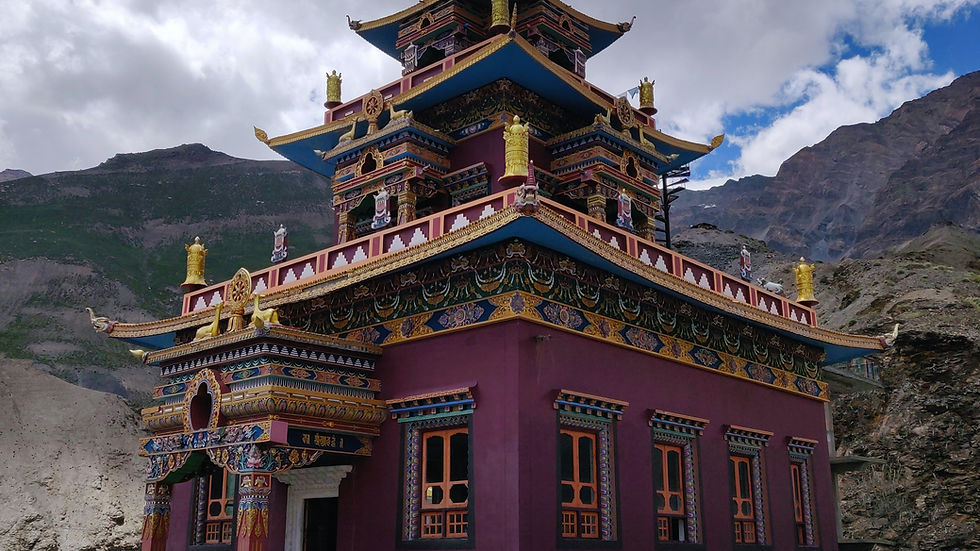
At the centre of Gue Mummy Village folklore is Sangha Tenzin, a Buddhist monk believed to have lived in the fifteenth century.
According to local belief, Sangha Tenzin practised an extreme form of ascetic meditation that eventually led to self-mummification. This was not an act of fear or punishment. It was considered a final spiritual offering, a deliberate choice to remain as a guardian after death, so that his presence would continue to protect the land and its people from harm.
The process, known in Tibetan and Japanese Buddhist traditions as tukdam or sokushinbutsu, involved extreme fasting, meditation, and a gradual withdrawal from physical sustenance until the body itself became the offering. It was one of the most severe acts of spiritual devotion documented in Buddhist history.
Centuries after Sangha Tenzin entered this state, his body was discovered seated upright in meditation, remarkably and completely intact.
For the villagers of Gue Mummy Village, this was not shocking. It was expected.
What Science Found When It Arrived

The preserved body of Sangha Tenzin has drawn attention from historians and researchers worldwide. Carbon dating studies suggested that the monk has been in this state since the early fifteenth hundreds. No chemicals or artificial preservation methods were found.
The body was naturally preserved due to the combination of extreme altitude, sub-zero temperatures, and the extraordinarily dry climate that defines Spiti for most of the year.
His skin, though darkened with time, remains intact. His hair, eyelashes, and teeth are still visible. His posture has not changed.
From a scientific perspective, Gue Mummy Village represents a rare convergence of environment and human discipline, where the conditions outside perfectly preserved the intention within.
From a local perspective, science simply arrived late to something faith already knew.
Why Locals Believe Sangha Tenzin Still Protects Gue
The chamber where Sangha Tenzin sits is maintained with care. Offerings are made daily, not out of obligation or ritual habit, but out of genuine respect for someone the villagers consider still present.
Elders speak of scorpion infestations disappearing from the village in ways that felt connected to the monk's presence. They speak of crops surviving winters that should have destroyed them, and of disasters that turned away from Gue when they struck elsewhere in the valley.
In Gue Mummy Village, protection is not dramatic. It does not announce itself. It is simply constant, the way mountains are constant, the way cold is constant. It is there whether or not you are paying attention.
What It Feels Like to Stand in That Room

There is thick glass separating visitors from Sangha Tenzin. You stand only a few feet away.
His eyes remain partially open. His posture is unwavering. His presence feels heavy in a way that words reach for but do not quite find.
Time behaves differently inside the chamber. Conversations stop mid-sentence. Phones lower without anyone deciding to lower them. Even people who arrived with the energy of tourists leave with something quieter.
The monk does not demand attention. He simply holds it.
Gue Mummy Village does not ask you to believe in what happened here. It only asks you to slow down long enough to feel the weight of five hundred years in a single room.
How to Visit Gue Mummy Village

Best time to visit: May to October when the Spiti circuit is open and the road to Gue is accessible. For the best time to plan your Spiti trip overall, read our best time to visit Spiti Valley guide.
Opening hours: The monastery at Gue is generally open through the day but has no fixed hours. Visiting in the morning, between 9 AM and noon, tends to give you a quieter and more unhurried experience before other groups arrive.
Entry: Rs 30 per person, collected at the village for local development. Carry cash since there is no digital payment option here.
What to carry: Water, a light jacket even in summer since the altitude means temperatures drop quickly once you are out of direct sun, and read our Spiti Valley packing list before you head out for the full breakdown.
Photography: Allowed outside the chamber. Inside, the glass creates reflections so most people end up simply standing rather than shooting. The exterior of the monastery against the surrounding mountains is worth as much time as the interior.
Respecting Gue Mummy Village
Photography is allowed but silence is expected. No rules are written on a board at the entrance. The expectation exists regardless because anyone who arrives with the right attention understands it immediately.
Do not touch the glass. Do not speak loudly inside the chamber. If you bring a group, let the experience settle before you start discussing it. Some places deserve to be felt before they are analysed.
Gue Mummy Village is not a spectacle. It is a reminder that faith can outlast flesh, and that some choices are made not for the living but for everyone who comes after.
Understanding Self-Mummification in Buddhist History
Practices similar to Sangha Tenzin’s devotion have been documented in Tibetan and Japanese Buddhist traditions. Monks prepared for death through prolonged meditation and renunciation.
Historical explanations help understand the process. Folklore explains the meaning. Both can exist without diminishing each other.
Visiting Spiti with Panny Fack India
Gue is a stop on Day 4 of our Spiti road trip, the Tabo to Kaza leg that also passes through Nako. Most groups spend 30 to 45 minutes here. Some stay longer without meaning to.
We run the full Spiti circuit every season via tempo travellers and SUVs from Delhi. Browse our Spiti Road Trip for the full itinerary and current departure dates, or see all our Road Trips if you are comparing options.
FAQs: Gue Mummy Village

How far is Gue Mummy Village from Kaza?
About 60 km, roughly 1.5 to 2 hours by road depending on conditions. It sits on the Tabo side of the circuit and is most naturally visited as a day 4 stop on the Shimla entry route.
Can I visit Gue Mummy Village independently?
Yes. There is a Rs 30 per person entry fee collected at the village for local development. No permit is required. You need your own vehicle or an arranged cab since no public transport goes directly to Gue. Most Spiti group trips include it as a planned stop.
Is the monk real or a legend?
Real. The body of Sangha Tenzin is physically present in a glass chamber at the monastery in Gue. Carbon dating has confirmed it dates to the early fifteenth century. Both its existence and its state of preservation are documented.
Who was Sangha Tenzin?
A Buddhist monk believed to have lived in the fifteenth century who practised self-mummification as an act of spiritual devotion, choosing to remain as a protector of the Gue village and valley.
What is the Gue mummy story?
The Gue mummy story centres on Sangha Tenzin, a fifteenth century Buddhist monk who chose self-mummification as a final spiritual offering to protect the village. Centuries later his body was discovered seated in meditation, completely intact, and is now kept in a glass chamber at the monastery in Gue where locals still consider his presence protective rather than historical.
Why is Gue Mummy Village significant?
It is one of the very few places in India where a naturally mummified monk can be seen by the public. More than the rarity, it is the manner of preservation and the continuing local belief around Sangha Tenzin that gives the place its particular weight.
Is Gue Mummy Village open in winter?
The village is accessible in winter for those on specialised expeditions, but the road conditions make independent travel difficult. Our Spiti Winter Expedition covers the route during the winter months.
Panny Fack India runs Spiti road trips and winter expeditions from Delhi every season. Gue is a planned stop on the route. See the Spiti Road Trip or WhatsApp us with your dates.


Comments